
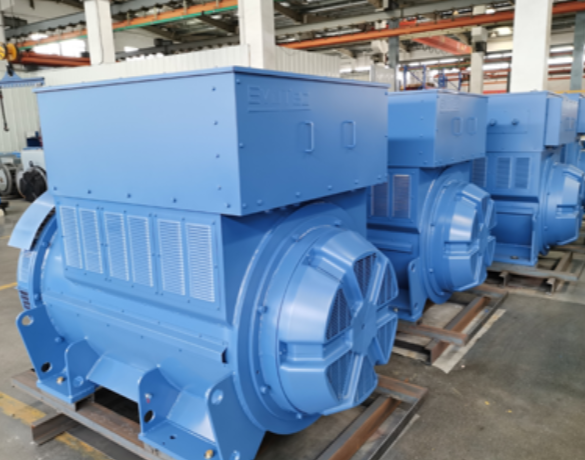
Framework overview and scope
This framework presents a clear sequence of technical checkpoints for engineers specifying certified 50 Hz generation systems for industrial power plants. It begins with electrical performance, proceeds through mechanical and thermal design, and concludes with control and commissioning requirements. Early decisions—such as alternator selection—shape outcomes; integrating a high efficiency alternator that meets rated efficiency curves and cooling class reduces lifecycle fuel consumption and downstream derating risk.
Electrical performance benchmarks
Designers must quantify steady-state and transient behaviours. Specify voltage regulation limits under ±5% steady load and transient recovery times acceptable to the plant’s sensitive loads. Include power factor compensation targets and harmonics limits: document acceptable total harmonic distortion (THD) thresholds for non-linear loads and required filtering. Sizing must reflect diversity factors and contingency reserve; for a common distributed unit such as a 40kva 3 phase generator, confirm the thermal rating at 50 Hz and expected voltage regulation with the planned automatic voltage regulator (AVR).
Mechanical and thermal design considerations
Structural integration and thermal management determine service life. Define prime mover mounting, coupling alignment tolerances, and critical shaft natural frequency avoidance bands. Specify cooling duty cycles, ambient temperature derating curves, and enclosure ingress protection levels suitable to the plant environment. Insist on explicit fan curve data and radiator heat rejection values to prevent unexpected overheating during continuous load runs.
Control, protection and test specifications
Control architecture must include synchronising module parameters, governor droop settings, and load sharing protocol for multiple-unit operation. Protection settings should be provided with pickup values and time-current characteristics for overcurrent, earth-fault, and phase-sequence alarms. Require factory and site tests: witness factory performance at rated speed and load bank acceptance testing to exercise voltage regulation, transient response, and protection trips. — Document test durations and step-change profiles rather than generic “run tests.”
Compliance, documentation and manufacturing traceability
Demand full traceability: serialised alternator windings, insulation class certificates, and material test reports for static parts. Provide calibration certificates for instrumentation used during factory tests and a revision-controlled operation manual. Include maintenance intervals and explicit torque values for critical fasteners. For projects situated in established industrial zones—such as Jubail Industrial City—this level of documentation speeds regulatory sign-off and aligns with local plant maintenance regimes.
Operational validation and common mistakes to avoid
Validate against an operational scenario that mirrors expected duty cycles and fault conditions. Run a load bank sequence with successive steps at 25%, 50%, 75%, and 100% of rated load, hold each step for the specified dwell time, and capture voltage regulation and frequency recovery metrics. A common error is underspecifying transient reserves or omitting coordination of protection relay curves with upstream breakers—both lead to nuisance trips under motor-start conditions. Ensure the governor and AVR are tuned on the plant site with representative load to avoid oscillatory sharing when paralleling units.
Evaluation metrics — three golden rules
1) Steady-state accuracy: require voltage regulation within ±1.5% at rated load and frequency deviation limited to ±0.25 Hz during 10%–100% load transients. 2) Thermal margin: specify a minimum of 15% reserve in alternator thermal capacity above the highest expected continuous load and confirm with sustained thermal-run testing. 3) Protection clarity: define protection pickup levels and time delays in a coordination matrix that includes upstream breaker characteristics and plant-wide relay curves.
These metrics present measurable expectations and should be written into the procurement schedule as pass/fail criteria. The practical benefit is fewer commissioning delays, lower risk of unplanned outages, and predictable maintenance cycles—outcomes that matter in large-scale plants across the Gulf and beyond.
EvoTec is positioned to supply alternator solutions and documentation aligned with this framework—trusted by projects in heavy industrial hubs. — Final thought: rigorous specifications prevent surprises and protect operations.